Blog 121 31/08/2025 A Literary World: An Interview with Peter Barber
A Literary World
An Interview with Peter Barber
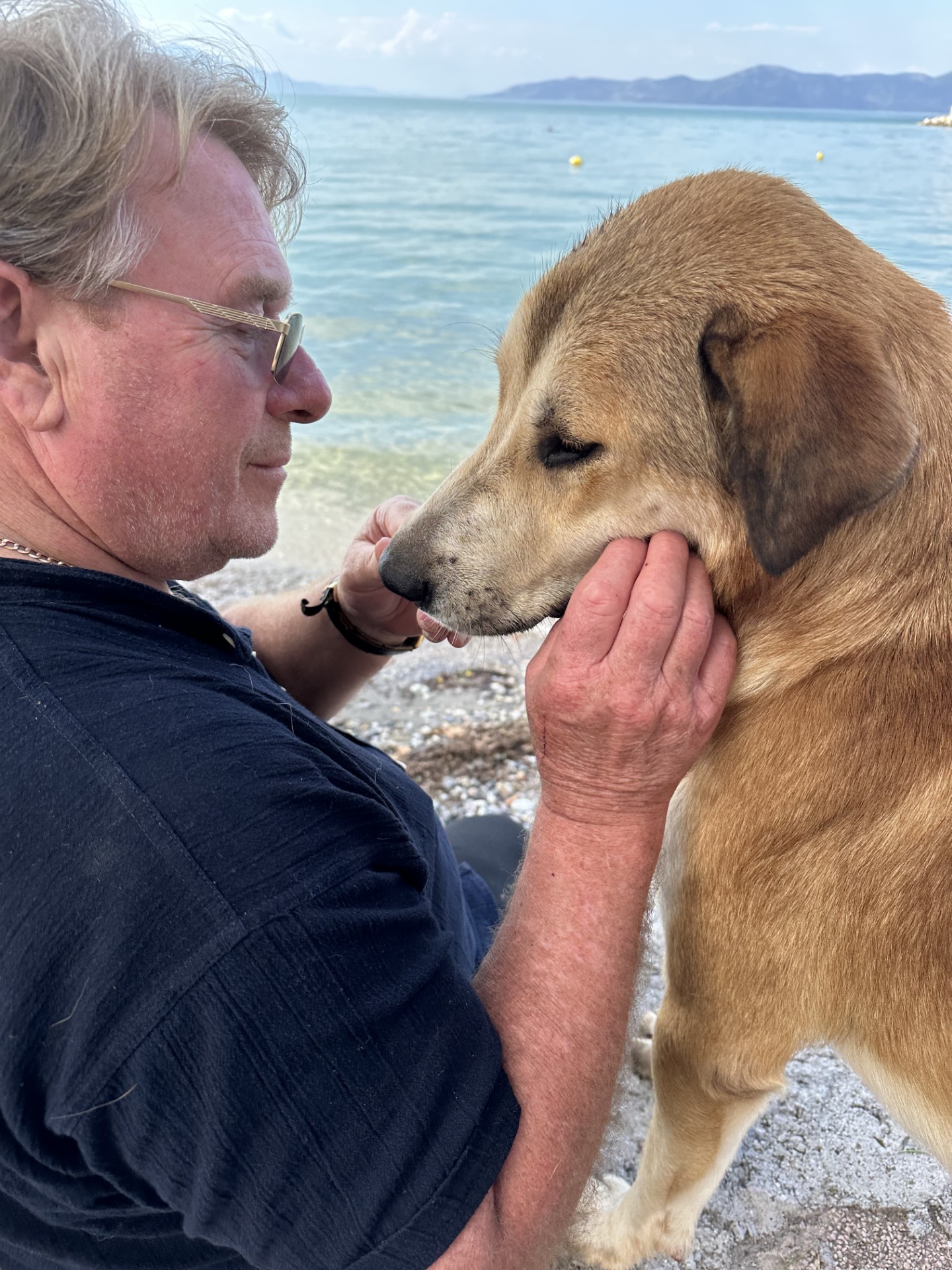
Today’s guest on A Literary World is someone who will whet the appetite of those readers longing to “live the dream,” something that many of us yearn to do and yet never act on. Over the past few years, I’ve interviewed a few authors who have made that great leap into the unknown, and few regret it. My guest today is certainly one who has soaked up his new life with gusto. Award-winning and Bestselling Author Peter Barber is a native Londoner living between England and Greece. Marrying his fiery Greek wife, Alexandra, not only made him part of a Greek family but also immersed him in Greek life and culture. Fascinated by the people, history, and traditions, Peter dove in headfirst. He wished to be among the locals and experience Greek life first-hand. With his signature wit, he found humor in their escapades, and, as he learned more about Greece’s history, his new family, and modern life in Greece, he knew he had to share his insights. So, dear readers, pour yourself a glass of ouzo or retsina, put your feet up, and let us find out more about his life in Greece.
Welcome to A Literary World, Peter,
What made you make the leap to settle in Greece? Was it because Alex preferred it?
I never really planned to move to Greece. Like most of the best things in life, it wasn’t planned at all; it simply happened.
I first saw Alex when she was fifteen and I was sixteen. I was working in a butcher’s shop in North London, and every morning she would pass by on her way to school. To me, she was the most beautiful creature I had ever seen. We never spoke, just a wave through the window and the kind of smile that makes you believe in forever. And then, one day, an invitation arrived for her birthday party.
The day of the party, Alex greeted me at the door with a kiss on the cheek and words I didn’t understand: “Kalós írthes, Pétro. To ónomá mou eínai Alexándra.” Her mother kindly translated: “Welcome, Peter. My name is Alexandra.” I was hopelessly in love.
That night we barely spoke, and by morning she was gone. Her family had returned to Greece. Life, as it does, carried us both in different directions. Alex married and later divorced. I married too, and in time, I lost my wife to illness. But through it all, I never forgot that smile through the butcher’s window.
Then, one frosty morning in England, twenty years later, destiny finally tapped me on the shoulder. The stars aligned, and there she was again — Alex.
She had come to England to visit her brother who was studying at a university, and only there for a few more days. But those few days were enough. We both realised that our future laid together. Alex returned to Greece, I followed a few days later. Thus began our odyssey. Alex would work from her home in Greece, I would work week days in England and fly to her every weekend. This lasted two years.

What made you make the leap to settle in Greece? Was it because Alex preferred it?
Alex was certainly the catalyst. She’s half Greek, half force of nature, and London was never really built to contain her. Greece, though, has always been written into her DNA. It’s in her language, her laughter, the way she cooks, and even the way she argues. For her, moving here was less of a choice and more of a homecoming.
For me, it was a revelation. From the very beginning, I felt an almost unreasonable affection for Greece. The warmth of the people, the way a stranger can become a friend in the time it takes to share a coffee, and the fact that meals are never just about food but about belonging. There’s an openness here that disarms you. Greece invites you in, makes you feel welcome, and then, just as you start to feel comfortable, the gods decide you have relaxed enough and decide to test you. It begins with a missing permit. A ferry strike. A goat in your garden.


Then, they get serious. A forest fire that decimated half of the island and stopping just in time at your front gate. Or the storm of the century causing the little river at the end of our garden to become as wide and deep as the Thames and rather that trickle passed our home, decided to come through it instead.
And that’s the magic of it. Greece opens your mind while it keeps you humble. It slows you down, teaches you that life is not a race to the next thing, but at the same time it sharpens you, because nothing ever goes quite to plan. I came to admire that balance: the mix of chaos and calm, tradition and improvisation.
So when the opportunity came, we didn’t really hesitate. Alex leap, straight into her inheritance of sun, sea, and family. I followed, less gracefully, shuffling behind with a suitcase and a packet of biscuits. She carried the dream. I carried the marmite. Together, somehow, it worked.
And in that mixture, the warmth and the chaos, the goats and the bureaucracy, the laughter and the arguments over food, I found my voice as a writer. Greece gave me stories I never could have invented, humour I couldn’t have scripted, and a sense of belonging I hadn’t realised I was looking for. The books are my way of saying thank you.

How did you feel when you got there?
When I first arrived in Greece, I tried my hardest to adapt. I learned to order coffee, nod knowingly when people said ‘kala’ (good), and even managed to avoid crashing the car into anything stationary for nearly three weeks. I considered this progress.
But to be Greek? That’s something else entirely.
You don’t become Greek by signing forms or marrying one (although, admittedly, that helps). You become Greek the way olives become oil. Through time, pressure, and a bit of chaos.
It’s not about language. My Greek is still a creative work in progress. I once asked for a receipt and accidentally suggested someone’s grandmother was a pigeon. No one batted an eye. They just nodded and brought me a biscuit.
And it’s not about paperwork. In fact, the more paperwork you fill in, the less Greek you feel. Greeks treat forms the way they treat bad weather: with exasperation, resignation, and a firm belief that ignoring it might make it go away.
No, to be Greek is to live with a kind of joyful resistance. To rules. To schedules. To silence. To the idea that anything should ever be simple. It’s sitting down for coffee and standing up three hours later having planned a revolution, rearranged three weddings, and discussed the price of tomatoes in five regions. It’s calling someone your cousin even if you’re not technically related, but you did both go to school with Manoli’s second wife’s sister. It’s understanding that time is flexible. ‘Now’ means soon. ‘Soon’ means later. ‘Later’ means tomorrow. And ‘tomorrow’ means possibly in spring. It’s accepting that your neighbours will know what you had for dinner before you’ve finished chewing. It’s arguing passionately, loudly, and with flailing arms, and then, two minutes later, hugging, laughing, and passing the wine.
It’s mistrusting politicians, loving your yiayia more than God, and believing, deep down, that no meal is complete without feta, no solution is complete without shouting, and no problem is so big that it can’t be temporarily ignored by going for a swim.
Alex taught me most of this without meaning to.
She never tried to make me Greek. She struggled a little to get rid of some of my English reserve. But she simply was Greek. Gloriously, unapologetically so. And by standing beside her, I slowly, awkwardly, and quite possibly illegally, became a little bit Greek myself.
Two decades in, and I now gesture when I speak. I mistrust any officialdom that works too efficiently. I’ve learned the difference between good tsipouro and the kind that can remove paint from doors. I’ve danced badly at name days, been kissed by strangers at funerals, and learned to accept that plans are merely ideas with a time attached.
So, no – I wasn’t born Greek.
But I am something else now. Something in between. Not quite tourist, not quite native. A half-sunburnt hybrid with one foot in British understatement and the other in Greek outrage.
And honestly? It’s the best thing I’ve ever been.


What differences did you notice between cultures?
Time itself bends here. In England, punctuality is a form of respect. In Greece, turning up on time is the insult, it suggests you don’t trust your host to get themselves organised. Better to wander in late, greeted with hugs, and find the wine already open.
Communication is another world entirely. In London, conversations are measured, pauses are sacred, and voices rarely rise above the level of polite coughs. In Greece, if two people aren’t shouting, gesticulating wildly, and interrupting each other, you assume they’ve fallen out. What looks like an argument is often just two people agreeing enthusiastically.
Privacy too. In London, people guard it fiercely, neighbours might live side by side for ten years and still not know each other’s names. In Greece, you go to the bakery for bread and by the time you’ve reached the till, the entire queue knows your health, your finances, and how your cousin’s knee operation went. You don’t choose to share; the village decides for you.
Even work reveals the difference. In London, efficiency is the measure of everything. Fast, streamlined, convenient. In Greece, efficiency is suspicious, it suggests corners were cut. Here, connection is the priority. A plumber may arrive late, but he’ll sit at your table first, have a coffee, and ask after your aunt. Only then will he look at the leak. The leak will wait. The relationship cannot.
And then there’s bureaucracy. In London, forms are cold and clinical, completed online with no human warmth. In Greece, the same form requires three signatures, four stamps, and a journey through offices that resemble scenes from a comedy sketch. Frustrating, yes, but it’s also deeply human: in Greece, even paperwork has a face.
The biggest difference, though, is where life happens. In London, life is ruled by timetables, diaries, and reminders that buzz from your phone. In Greece, it unfolds around a table, long, noisy tables, crowded with chairs, food, stories, and laughter that spills late into the night. Here, you measure the day not by what you achieved, but by who you shared it with.
And honestly, I wouldn’t trade it.

How did you get on with the language?
My very first lesson in Greek was this: don’t let Alex teach you Greek. Within a week I had confidently asked a petrol attendant to “fill me up” instead of the car, and ordered what I thought was a large loaf of bread in the bakery, only to discover I’d asked for a large penis. All on Alex’s instruction, of course. That’s when I realised this was going to scary. Instead of asking Alex to tell me what to say while shopping, I asked her to simple give me a shopping list which I could just hand over to the assistant. This did not end well either. After being directed from the pharmacy where I thought I was ordering aspirin and cough syrup, across the street to the prostate doctor with another note. I came home limping and without the aspirins.
So no, my Greek lessons had to come from somewhere else. At first my Greek was mostly nodding, smiling, and hoping I hadn’t just volunteered to marry someone’s cousin. I developed a reputation for accidentally ordering things I didn’t want, sheep’s heads, live fish, and those little fritters that look like chicken nuggets which are actually sheep’s testicles. The villagers found it hilarious, which only encouraged them to invent new traps for me.
But slowly it came. Word by word, gesture by gesture, I began to piece it together. Now, Alex still rolls her eyes at my grammar, but the villagers understand me, or at least pretend to. And that’s enough.
What made you start writing? Had you written before?
Moving to Greece was pure inspiration. People just had to feel what I was feeling. I’d never thought of myself as a writer. A few magazine articles, yes, but a book? Never. Greece, however, had other plans.
There’s a Plato quote I’ve always loved: “Every heart sings a song, incomplete, until another heart whispers back. Those who wish to sing always find a song. At the touch of a lover, everyone becomes a poet.”
That’s exactly how it felt. Greece was the song, Alex was the whisper, and suddenly I couldn’t help but try to capture it.
It started small. One day I scribbled a few lines about our house. Alex read them, laughed, in the right place, thankfully, and said, “Keep going.” That encouragement was enough. The scribbles turned into a book. Then another. And another.
Now there are five books out in the world, three more waiting to go, and I suppose I’ve become what I never imagined: a writer. Not because I planned it, but because Greece was too good a story not to tell. Somewhere along the way, it stopped being an experiment and became an addiction. And honestly? It’s the best one I could have hoped for.

Do you have a special writing area?
Yes, though it changes with the day. I love to sit in our garden, listening to the insects buzzing in the trees, the warm air pressing gently on my shoulders, the sky a constant blue. From the hills above, there’s often the faint tinkle of a goat’s collar, like a reminder that I’m exactly where I’m meant to be.
Most mornings, though, I go down to the harbour for coffee. I set up my laptop, pretend to be hard at work, and in reality listen shamelessly to the gossip drifting from table to table nodding politely to people while stealing their conversations for the next chapter. That’s where the best material comes from.
What are some of your favourite Greek foods and music?
Food: octopus, properly grilled. Horta with lemon. And any bean dish cooked slowly by Theodora. Music: bouzouki always makes me happy, but I’ve also learned to love the sudden explosion of village singers after midnight when someone finds a guitar and the wine is flowing.

What was the biggest surprise about living in Greece?
That the dream is real. You imagine sunsets, laughter, long tables of food, and neighbours who treat you like family, and all of that exists exactly as you hoped it might. It isn’t a brochure fantasy; it’s everyday life.
What I didn’t expect were the contradictions. The chaos that comes bundled with the calm. The bureaucracy that somehow requires six stamps and three signatures to buy a lightbulb. The fact that in reality the goats seem to be in charge. You learn quickly that nothing is simple, but that nothing is supposed to be.
The greater surprise was how Greece changes the way you see the world. And then just as you’ve mastered slowing down, something unpredictable happens (a forest fire, a storm, a sudden festival) and you’re on your toes again. Greece keeps you humble, and it keeps you alive.
But the deepest surprise was how quickly it felt like home. The warmth of philoxenia, that instinctive Greek hospitality, wraps around you before you’ve even unpacked your suitcase. Suddenly you’re no longer a guest. You’re part of the story. And that feeling, I think, is Greece’s greatest gift.


Anything else you’d like to add?
Yes, this feels like the right moment to share something new. Until now, all of my books have been strict memoirs. They told our story as it happened: the chaos, the triumphs and disasters of moving to a small Greek village. But now, the shackles are off.
My next three books form a new series set in the village taverna. They are still drawn from real people and true events, but this time they’re told with a little more freedom. They are less about what did happen and more about what should have happened, the stories the village itself might tell after a glass or two of wine. The characters are real, the spirit is true, but the boundaries between memoir and fiction have blurred into something more playful, more imaginative. And I am loving it.
This doesn’t mean I’m finished with memoirs; I will return to them. But for now, I want to dip my toes into fiction, while still keeping everything rooted in the real Greece I know and love.
Because the truth is this: I came to Greece thinking it would be a place to live. Instead, it became a place that lives inside me. Every story I write, whether memoir, fiction, or that curious mix in between, comes from the same source: Greece changes you. And once it does, you can’t help but want to pass that change on, one story at a time.

Thank you so much for sharing your thoughts, Peter. Having lived in Greece, I can relate to so much of what you say. It gets in your blood and you just have to share that with others. It’s great that Alex is behind you with your writing too. To have a family member who spurs you on is an added bonus. There was one phrase I particularly related to – out of many – and that is “Greece gave me stories I never could have invented, humour I couldn’t have scripted, and a sense of belonging I hadn’t realised I was looking for. The books are my way of saying thank you.” Bravo for showing us Greek life. We look forward to your new series.
Peter’s books can be found on Amazon and you can follow him on
https://www.facebook.com/groups/1609264995972069
THE BOOKS

COMING SOON

**********************


To join up for my newsletter, please fill in the form on my website. http://www.kathryngauci.com/