Blog 122 07/12/2025 A Literary World: An Interview with Author Sharon Blomfield
A Literary World
An Interview with Author Sharon Blomfield
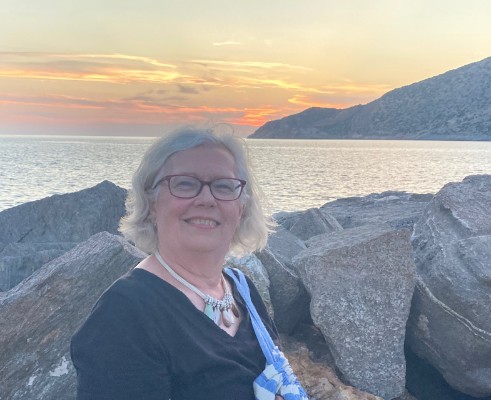
This edition of A Literary World features a writer I’ve known for some time now. Sharon Blomfield lives in Canada and I am in Melbourne, but despite the distance, our love of Greece has brought us together. Sharon fell in love with an island that I’ve always wanted to visit, but so far, I have not made it. Sifnos is one of those stunning, rugged Cycladic islands with blinding white architecture. When I lived in Greece in the 1970s, it was well-known for its ceramics, and I am glad to see it still is. I asked Sharon to tell us what drew her to Sifnos and about her books set on the island. Without further ado, over to you, Sharon. Please tell us your story.

Apollonia
Thank you for featuring me on your blog, Kathryn. People tell me I light up when talking about my travels to Greece and my books, non-fiction travel narratives set on the Cycladic island of Sifnos, The Sifnos Chronicles series. The first book’s subtitle, tales from a greek isle, best describes what they’re about. They tell of real people, events told as they happened, and of a Canadian traveller, who, to her surprise, finds herself returning again and again to a place where she comes to feel more at home than almost anywhere else. They’re stories of open-heartedness, of warmth, of spontaneous generosity, and of laughter. So much shared laughter. And of treasured friendships that have developed over time. I also write the blog, The Sifnos Chronicler, which focuses on factual aspects of life on the island.

Urban landscape

Eftamartyres (Seven Martyrs Church)
It was my photographer husband and travelling companion who suggested Sifnos in 2006 when we were contemplating a first visit to Greece and looking for somewhere for a three-week stay. Its architecture is some of the finest in the Cyclades, his research said. The island is crisscrossed with ancient marble-paved hiking trails. It has no airport, and its culture is still typically Greek. He was sold. When he mentioned bougainvillea, I was too. Surely, in whatever my experiences there would be, I’d find enough material for two or three travel stories that I, an occasional freelance writer, was doing for newspapers and magazines at the time. After finishing my career as an elementary school teacher a few years earlier, I had no desire to take on any more of a job than that.
 The plan, such as it was at the time, was that we would visit Sifnos once, explore it in whatever depth we could in that time, and that would be it. Future travels would take us elsewhere. The island, though, had other ideas about that. From the very first steps I took onto its soil, it felt as though I was living in the middle of a narrative tale, with a succession of characters wandering in and out of my days. Every time they reappeared, I’d learn something new about them and their way of life, unlike any I’d experienced before. Fascinating and quirky, often unwittingly funny, always open-hearted and kind, they filled this trip’s notebook faster than any I’d kept anywhere else.
At the end of those three weeks, I craned my neck from the cab taking us back to the ferry to take in every detail, so sure I’d never see Sifnos again. There was time for a final meal in one of the port town’s tavernas and, during it, various of these characters, living their lives and oblivious to yet another pair of departing tourists, passed by again. Whether they knew it or not, and they certainly did not, I took this as their good-bye. Then, as we were about to gather our suitcases and backpacks and take those final steps toward the dock, the most outrageous Sifnian of them all appeared and stuck his head in through the door. He started, as usual, into that routine of his, one he imagined would bring him plenteous attention and applause and never did. Though this was almost twenty years ago now, I can feel that moment still. Like a bolt of Zeus’s lightning, It’s a book, the thought struck.
A book? A whole book? No way! I’m quite certain my mouth was hanging wide open.
Once back home, this idea would not let go. It was as though the island had taken me by the hand, given it a firm shake, and was insisting still, “There’s a book here, and you are the one who must write it.” When I gave in and sat down to write, I soon learned that I needed more material. So two years later, we were back.
We’ve returned a dozen times now, always for a month at a time, people are always right where we expect them to be, and almost as though no time has passed in between, the story carries on. The Sifnos Chronicles: tales from a greek isle was my first book, Sifnos Chronicles 2: more greek island tales, the second, and I’m close to finishing a third one right now. And what I’ve learned more than anything else, is that writing these books gives me the privilege of being in Sifnos every single day.


Sifnos is an island whose loyal visitors from elsewhere in Greece and abroad return often. Yearly in many cases. Even more often than that with some I’ve come to know. “You come only once, or forrrrr-ever,” says one taverna owner. We met him within the first hour we ever set foot on the island, and whenever we return now, there’s no question but that our first dinner will be at his place. “It’s tradition,” he says every single time. It’s where we go for our last dinner, too, and mostly every second day in between.

Rural landscape
The island is noted for its food, and sailors in the Greek merchant marine have long considered themselves lucky if they have a Sifnian cook in the galley. The making of ceramics developed very early on in Sifnos, earlier than in many other parts of Greece and the rest of the world. As a result, a rich and nuanced cuisine developed. Mastelo, lamb stewed in a clay pot with red wine and dill until it falls off the bone. Revithia, chick pea soup, cooked slowly, slowly in communal wood ovens all over the island every week from Saturday night until Sunday at noon. As I write these words, my mouth waters. I must say that the revithia I cook back home, even though an electric version, tastes pretty good.

Taramasalata and Kaparosalata (caper salad)

Revithia
Which authors have inspired your writing journey?
Two in particular inspire me. The late Peter Mayle could take the most ordinary of happenings as an English homeowner in the south of France and spin these into story gold. A Year in Provence begins with the opening line, “The year began with lunch,” so simple, so brilliant, and unfolds from there. Donna Leon’s writing mesmerizes me too, hers for the sense of place she creates. She places me right there in Venice, where she lived for many years, following in the wake of her fictional detective, Ispettore Guido Brunetti, as he scoots over the bridges, along canal-side rive, and into warm corner bars for espresso and conversation. What these two authors share in common is that both chose to live in and write about cultures far different from the ones where they grew up. As outsiders, they notice what natives take for granted, and realize that in these details lies the essence of a place and its people.
Then there are all of the others from abroad that Greece has turned into book authors, whether of fiction, memoir, or any other narrative form. I knew little about this phenomenon when it happened to me. Since then, I’ve begun to see how large a community this is, how kind and supportive of each other. Qualities that reflect what we’ve seen Greek people live every day.

Seven Martyrs Church
At the launch party for The Sifnos Chronicles: tales from a greek isle, held in a Greek Canadian’s food shop, I watched the host, Dora, listen as I read aloud the first few paragraphs of Chapter 1.
“You’re clearly not Greek. But you get us,” she said when I’d finished. Her eyes were sparkling. Then hers always are. I must mention, too, how much food she’d provided for the event, spanakopita, dolmades, various dips, much more. She’d invited a local Greek restauranteur to help, and I’d heard the two of them arguing as they set these out on the table. “You brought too much.” “No, you did.” Generosity and kindness, this above everything is what I’ve learned from Sifnians, and from all Greeks I know.
How lucky I am to have somehow stumbled into their midst. How wise of me to have spent so much time there.
Can you tell us more about Sifnos Pottery?
This year in November, only days before I write this, UNESCO honoured Sifnos and its long tradition of ceramics production by listing the island on its Creative Cities Network (UCCN) in the field of Folk Art and Craft. City? Well that’s a stretch. But the rest of it definitely is not.

his is the most traditional of all pottery shops on the island. The man who owns it taught younger potters the craft, saving the art form from being lost.

The practice of pottery making began on Sifnos sometime in the Bronze Age and pieces still exist that are 4000 years old. It is said that when cooking elsewhere meant hanging a piece of meat over an open flame, here they were placing the bounty from their fields in clay pots, placing wild herbs on and around it ,and pouring wine over top, creating the kinds of dishes that are still beloved to this day.

But the making of ceramics is no mere archaic practice. It’s one that in the 21st century is carried on as enthusiastically as ever, its practitioners valued for their skills and for keeping this tradition alive. Pottery is everywhere. Plates, cups, cooking pots, water jugs, flower pots, decorative chimneys called flaros, ash trays, signs for businesses, even beehives in the ancient style, and pitchers that hold the home wine you ordered – if it’s possible to mould any item, practical or decorative, out of clay, it’s been done, and it’s used every day.

Ceramic chimneys

Flaros. The traditional chimney
Many of today’s potters use colourful glazes and motifs and have invented modern styles, but the traditional ones have not disappeared. Far from it. Many workshops produce nothing but, the kinds of pieces every Sifnian cook relies on. It’s unthinkable anyone on this island would make chick pea soup, its signature dish, in anything but a skepastaria, a lidded narrow-necked two-handled red clay pot. Equally unthinkable is the idea of using that pot for anything else. Or that your name wouldn’t be written on its outside so that when you go to the oven on Sunday at noon to pick up your revithia, you don’t leave with someone else’s. And yes, that has happened. It’s one of the stories that made it into The Sifnos Chronicles, my first book. The pot used to cook mastelo is larger in diameter, and more shallow. Instead of a lid, the dish is covered securely in tin foil before it goes into the oven. What the ancients used instead of foil, I can’t say, but they and their inventiveness are why you’re less likely to find grilled lamb on Sifnos than elsewhere in Greece. Even at Easter.

Ceramics Museum
Rare is the visitor, dare I say, who ever leaves without bringing at least one piece of pottery home with them. Certainly not I. No matter how many times I’ve been there, a few have always been tucked into our luggage somewhere. This being Sifnos, many of these over the years have been gifts. Most recently two boxes followed later, an entire set of kitchen dishes we ordered to be shipped to us back in Canada. And so, in addition to visiting Sifnos whenever I write, we touch it physically now at every single meal.

Kamares. The Port
Thank you so much, Sharon. I can see why you love the island. I too loved Peter Mayle’s A Year in Provence. I think it set many of us hankering after that other life in a gorgeous setting with quirky characters. On behalf of my readers, I do hope you return soon, and we look forward to the third book in the series.
You can find out more about Sharon on her website: https://thesifnoschronicler.wordpress.com/2025/05/24/a-vision-in-blue-and-white/
Facebook: https://www.facebook.com/sharon.blomfield.2025
The Books
Latest Release